
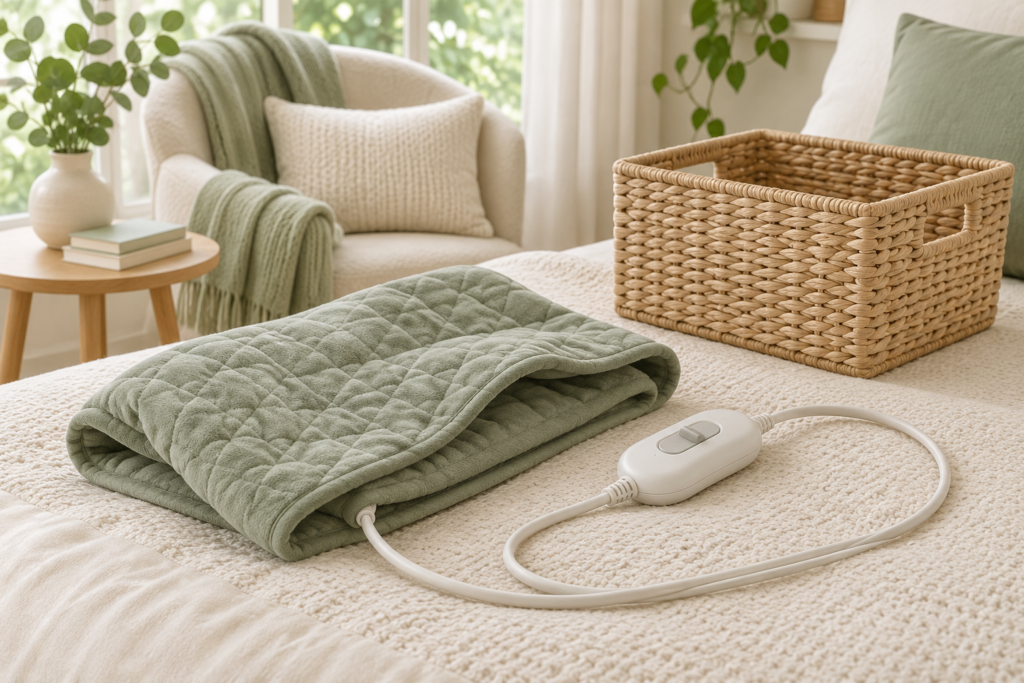
How to Store a Heating Pad and Cord Without Damage
Reviewed and updated: November 2, 2026
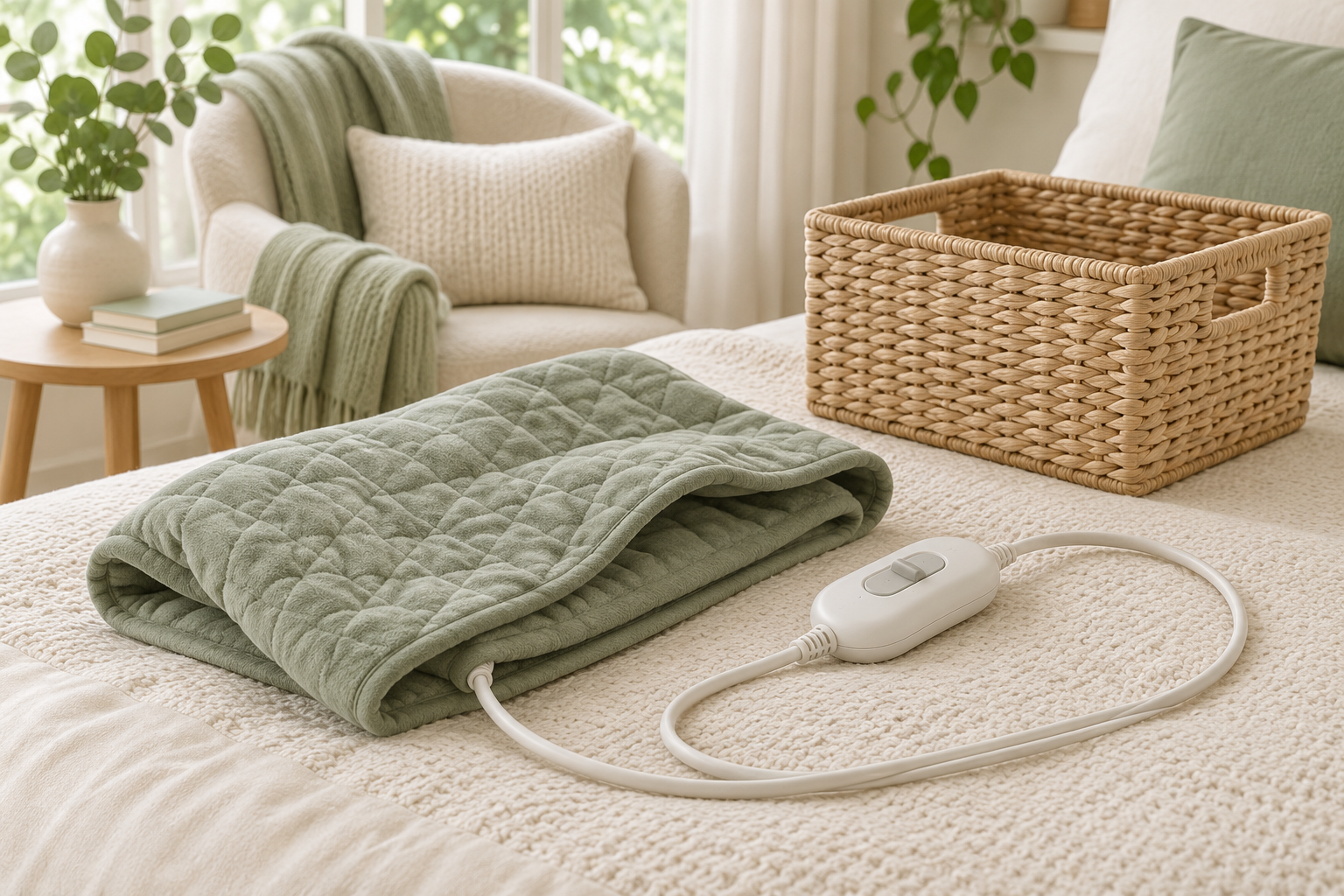
Heating pads are easy to damage in storage because the soft pad hides a network of wiring and the controller cord invites tight wrapping. A neat-looking bundle can be the worst option if it creates sharp bends, pinches the cord at the strain relief, or traps moisture. Safe storage is simple: unplug the pad, let it cool and dry, inspect it, fold or roll it loosely according to its instructions, and give the cord a wide loop.
Read the label before choosing a storage method
Heating pads do not all use the same internal construction. Some manufacturers permit a loose fold along natural seams, while others warn against folding and recommend rolling or laying the pad flat. Weighted, moist-heat, microwavable, and electric pads can have different care requirements. Use the manual for your exact model rather than copying how another pad is stored.
If the manual is missing, look for a model number on the pad or controller and find the manufacturer’s instructions. Until you confirm them, store the pad flat or in a broad, relaxed curve without putting objects on top.
Unplug and cool completely
Disconnect the pad from the wall before handling or storing it. If the controller or cord detaches from the pad, remove it only in the way the instructions describe; pulling at an angle can damage the connector. Never carry the pad by the cord.
Let the pad return to room temperature on a clean, dry surface. A warm pad pressed into a drawer can retain moisture and keep soft materials compressed around the heating elements. If the pad was used with a damp cover or moist-heat insert, allow every washable or removable layer to dry completely before reassembly.
Our heating-pad safety guide covers practical use habits, including checking the skin and avoiding sleep with an active pad unless the manufacturer specifically permits it.
Inspect before putting it away
Storage time is a useful inspection point. Run your hands lightly over the unplugged pad and look for stiff spots, unusual lumps, scorch marks, exposed wiring, frayed fabric, or a change in shape. Examine the cord at the controller, plug, and pad connector, where repeated bending tends to concentrate.
Stop using a pad with a damaged cord, cracked controller, loose connection, sparking, an unusual odor, or inconsistent heating. Do not repair an electric heating pad with tape or try to open the controller. Follow the manufacturer’s replacement or service guidance.
Make broad folds only when allowed
If the instructions permit folding, use the fewest folds possible and follow existing seams. Avoid creasing the center into a compact square. Internal heating wires can be stressed when the same sharp fold is repeated, especially if the folded pad is then compressed under towels or bedding.
Rolling is not automatically safer. A very tight roll can also strain internal parts and curl the edges. Think “large relaxed shape,” not “small travel bundle.” A wide shelf, shallow basket, or dedicated drawer lets the pad rest without pressure.
For a microwavable grain or gel wrap, check the care label for leakage, damp filling, torn seams, or odor before storage. These products are not interchangeable with electric pads, so keep their heating directions with them.
Loop the cord instead of winding it around the pad
Do not wrap the cord tightly around the controller or pad. That creates repeated bends at the strain relief and can twist the conductor inside. Instead, make several loose loops about the width of your forearm. Secure them with a soft reusable strap placed around the middle of the loop, not with a tight rubber band.
Allow a gentle curve where the cord enters the controller and pad. If the controller is detachable, store it beside the pad in the same basket so the correct components stay together. Do not force the connector into place or place weight on its pins.
The same principle applies to heated blanket storage and other flexible heated products: minimize sharp bends, crushing, moisture, and cord strain.
Choose a dry, moderate location
A bedroom closet or linen shelf is usually better than a damp basement, hot attic, bathroom cabinet, or car trunk. Temperature extremes and moisture can age plastic, connectors, and fabric. Keep the pad away from aerosols, leaking toiletries, candles, and sharp objects.
Place it where nothing heavy will be stacked on top. A breathable cotton storage bag or open basket protects it from dust without sealing in moisture. Avoid an airtight plastic bag unless the manufacturer recommends it and you are certain the pad is completely dry.
If children or pets can reach the shelf, choose a closed cabinet. A dangling cord is a pulling and chewing hazard even when the pad is unplugged.
Keep the controller visible
Controllers are easy to damage when buried beneath the folded pad. Place the controller flat beside the pad, with the display and buttons facing upward. Do not trap it between hard objects. If batteries are used in a separate control, follow the instructions for long-term storage and check for leakage.
Keep the instruction booklet or a labeled card with the model. The card can note whether the pad may be folded, whether the cover is machine washable, and which pieces must be detached before cleaning. This prevents household members from guessing later.
Pack a heating pad for travel carefully
For travel, give the pad its own section of the bag rather than using it as cushioning beneath shoes. Loop the cord loosely, protect the controller, and keep liquids in a separate sealed compartment. Do not compress the pad with packing straps.
Check voltage and plug compatibility before international travel. A simple plug adapter does not change voltage. Use the product only with the electrical supply allowed by its label. If the pad cannot be used safely at the destination, leave it at home rather than relying on an improvised converter.
Our guide to using heat therapy while traveling offers alternatives for situations where an electric pad is impractical.
Set up a quick return-to-use check
When you take the pad out again, unfold or unroll it fully and inspect the fabric, cord, plug, connector, and controller. Confirm that it lies as intended and that no object was stored inside it. Follow the manufacturer’s startup directions and remain present during use.
If storage has left a persistent sharp crease, do not iron, stretch, or heat the pad to flatten it. Contact the manufacturer or replace it if the instructions do not address the condition.
The best storage arrangement does not need to look perfectly compact. It needs to protect the wiring, cord, controller, and fabric. A cooled, dry pad resting in a broad shape, with a loosely looped cord and no weight above it, will be easier to inspect and safer to use the next time comfort is needed.